
Most patients who come to Davary & Smith having researched dental implants arrive knowing the basics: a titanium post replaces the missing root, a crown goes on top, and the result functions like a natural tooth. What they often don't know is that a meaningful percentage of implant cases require an additional step before placement can happen — one that determines whether the implant will have a stable, long-lasting foundation or fail to integrate properly.
That step is bone grafting.
Dental bone grafting is the procedure that rebuilds or augments the jawbone at the implant site when the existing bone volume or density is insufficient to support an implant. It is not a complication. It is a planned component of the treatment pathway for patients whose bone has resorbed following tooth loss, extraction, infection, or trauma — and it is among the most important services that a dual-degree oral and maxillofacial surgery practice offers that a general dentist placing implants cannot match in depth of training.
At Davary & Smith Oral & Maxillofacial Surgery & Dental Implant Center in Sterling, Virginia, Dr. Ashkan Davary, DDS, MD, and Dr. Christopher Smith, DDS, MD bring dual degrees in both dentistry and medicine — with comprehensive residency training in medicine, dentistry, anesthesia, and complex reconstruction — to every grafting and implant case. That depth of preparation matters most in exactly the cases where something beyond a straightforward placement is required.
Why Bone Loss Happens — and Why It Matters for Implants
The jawbone is a dynamic tissue. It responds to the mechanical demands placed on it: where teeth are present, the roots transmit chewing forces into the bone, signaling it to maintain density and volume. When a tooth is lost — through extraction, decay, injury, or gum disease — those signals disappear. The bone begins to resorb. The ridge that once supported the root narrows and flattens, month by month, in a process that continues indefinitely if nothing is done to stop it.
An implant requires sufficient bone height, width, and density to anchor the titanium post and support successful osseointegration — the biological process by which bone fuses with the implant surface. When adequate bone is not present, the implant lacks the foundation it needs. A post placed into insufficient bone may achieve initial stability but fail over time, or may not integrate at all.
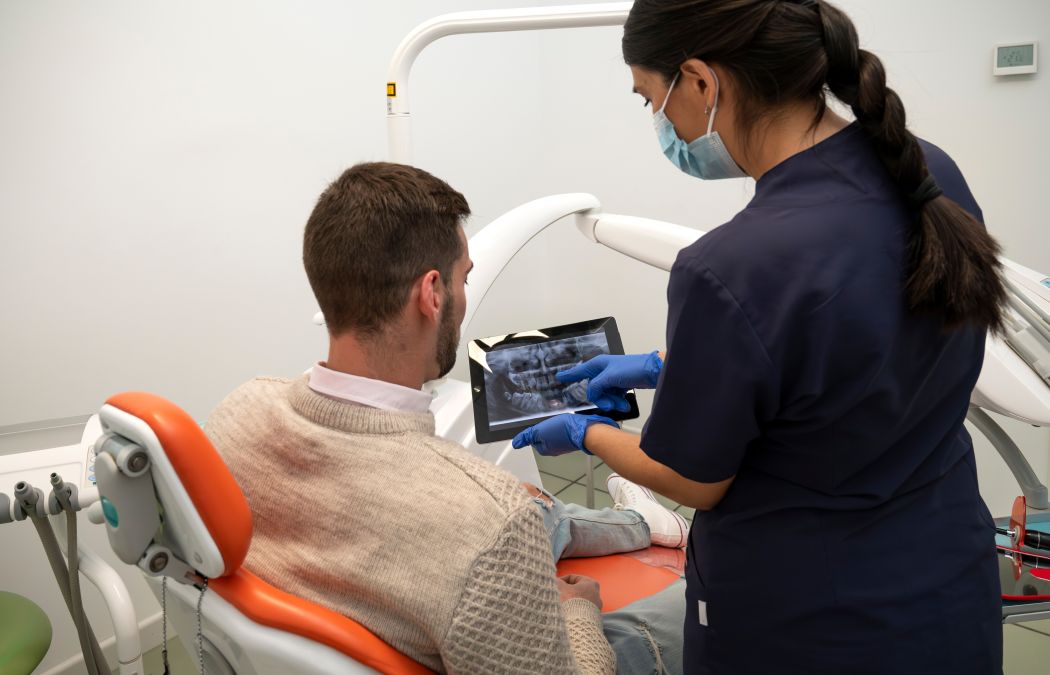
The assessment of bone adequacy is one of the first things evaluated in an implant consultation. Cone beam computed tomography (CBCT) — three-dimensional imaging that maps the bone architecture at the proposed implant site — provides the detailed picture that allows the surgical team to determine whether grafting is needed, what type, and how extensive.
Types of Bone Grafting — What Each Accomplishes
Bone grafting is not a single procedure but a category of procedures that vary based on what bone is needed, where it needs to go, and the clinical situation requiring it.
Socket preservation grafts are placed at the time of extraction to prevent the bone loss that begins immediately after a tooth is removed. When a tooth requires extraction and an implant is planned, placing graft material in the socket at the same appointment preserves the ridge volume that would otherwise resorb over the following months. This is one of the most effective ways to minimize the treatment complexity between extraction and implant placement.
Ridge augmentation addresses bone loss that has already occurred — the case most patients with a long-standing gap present with. Graft material is placed to rebuild the ridge to the dimensions necessary to accommodate an implant, and the site is allowed to consolidate before placement proceeds.
Sinus lifts are required when implants are planned for the upper back molar region, where the maxillary sinus can sit close to — or even penetrate — the proposed implant site. The sinus membrane is carefully elevated, graft material is placed beneath it, and the sinus floor height is increased to accommodate the implant. This procedure requires precise anatomical knowledge and surgical training that makes it one of the clearest differentiators between an oral surgeon and a general dentist with implant training.
Block grafts address more significant bone deficiencies using a solid piece of bone — often harvested from elsewhere in the jaw — rather than particulate graft material. These are more involved procedures reserved for cases where the bone deficit is substantial.
Graft Materials — What the Options Mean
Bone graft material comes from several sources, each with distinct clinical characteristics. The choice depends on the location, volume needed, and patient-specific factors.
- Autograft: Bone harvested from the patient's own body — often from the chin or the back of the lower jaw — provides the gold standard for biological integration, as it contains living bone cells. Used for larger defects where the graft material's own osteogenic capacity is important.
- Allograft: Processed bone from a human donor, carefully screened and sterilized. Highly predictable and avoids a second surgical site. The most commonly used material for routine socket preservation and ridge augmentation.
- Xenograft: Bone material derived from bovine (cow) or porcine (pig) sources, processed to remove organic components. Serves as a scaffold for new bone growth and is gradually replaced by the patient's own bone.
- Synthetic options: Calcium phosphate and other materials engineered to mimic bone mineral structure, used in specific clinical situations.
Dr. Davary and Dr. Smith's training in oral and maxillofacial surgery — one of the most rigorous surgical specialties in healthcare — provides the depth of experience with all categories of bone grafting that ensures the right material and technique is matched to what each patient's case actually requires.
The Timeline from Graft to Implant
Patients often want to know how grafting affects the overall treatment timeline. The honest answer is that it adds time — typically four to nine months for the graft to consolidate before implant placement proceeds, depending on the type and extent of grafting. In cases where socket preservation is placed at the time of extraction, the integration period begins immediately and may shorten the overall timeline between tooth removal and final implant crown.
This is one of the reasons early intervention matters. A patient who loses or extracts a tooth and has socket preservation placed at that appointment typically reaches the implant stage faster and with less additional grafting than a patient who waits years before addressing the gap, by which time significant ridge resorption has occurred.
Schedule Your Consultation at Davary & Smith
Davary & Smith Oral & Maxillofacial Surgery & Dental Implant Center is located at 21351 Gentry Drive, Suite 115, in Sterling, Virginia, serving patients throughout Northern Virginia including Loudoun County, Fairfax County, and the surrounding communities.
Call (703) 972-7773 or request an appointment online. If you've been told you need a bone graft before implant placement — or if you've been missing a tooth for some time and haven't yet had an implant evaluation — the summer is the right time to understand exactly where you stand and what the path forward looks like.
Connect With Us
Call (703) 972-7773 or request an appointment online to set up your first visit. We’ll be in touch soon.